Entropic Creation Religious Contexts Of Thermodynamics And Cosmology Science, Technology And Culture, 17001945
Helge S. Kragh
Estado :
Novo
Vendido por
País de expedição : Portugal Continental
Resumo
Ver tudo
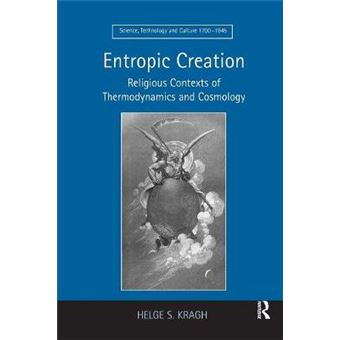
Entropic Creation Religious Contexts Of Thermodynamics And Cosmology Science, Technology And Culture, 17001945
Entropic Creation is the first English-language book to consider the cultural and religious responses to the second law of thermodynamics, from around 1860 to 1920. According to the second law of thermodynamics, as formulated by the German physicist Rudolf Clausius, the entropy of any closed system will inevitably increase in time, meaning that the system will decay and eventually end in a dead state of...
Entropic Creation is the first English-language book to consider the cultural and religious responses to the second law of thermodynamics, from around 1860 to 1920. According to the second law of thermodynamics, as formulated by the German physicist Rudolf Clausius, the entropy of any closed system will inevitably increase in time, meaning that the system will decay and eventually end in a dead state of...
Outras ofertas

Entropic Creation Religious Contexts Of Thermodynamics And...
Resumo
Entropic Creation Religious Contexts Of Thermodynamics And Cosmology Science, Technology And Culture, 17001945
Entropic Creation is the first English-language book to consider the cultural and religious responses to the second law of thermodynamics, from around 1860 to 1920. According to the second law of thermodynamics, as formulated by the German physicist Rudolf Clausius, the entropy of any closed system will inevitably increase in time, meaning that the system will decay and eventually end in a dead state of equilibrium. Application of the law to the entire universe, first proposed in the 1850s, led to the prediction of a future 'heat death', where all life has ceased and all organization dissolved. In the late 1860s it was pointed out that, as a consequence of the heat death scenario, the universe can have existed only for a finite period of time. According to the 'entropic creation argument', thermodynamics warrants the conclusion that the world once begun or was created. It is these two scenarios, allegedly consequences of the science of thermodynamics, which form the core of this book. The heat death and the claim of cosmic creation were widely discussed in the period 1870 to 1920, with participants in the debate including European scientists, intellectuals and social critics, among them the physicist William Thomson and the communist thinker Friedrich Engels. One reason for the passion of the debate was that some authors used the law of entropy increase to argue for a divine creation of the world. Consequently, the second law of thermodynamics became highly controversial. In Germany in particular, materialists and positivists engaged in battle with Christian - mostly Catholic - scholars over the cosmological consequences of thermodynamics. This heated debate, which is today largely forgotten, is reconstructed and examined in detail in this book, bringing into focus key themes on the interactions between cosmology, physics, religion and ideology, and the public way in which these topics were discussed in the latter half of the nineteenth and the first years of the twentieth century.
Nº de Páginas: 278
Encadernação: Capa Mole / Paperback
Tema: History
Entropic Creation is the first English-language book to consider the cultural and religious responses to the second law of thermodynamics, from around 1860 to 1920. According to the second law of thermodynamics, as formulated by the German physicist Rudolf Clausius, the entropy of any closed system will inevitably increase in time, meaning that the system will decay and eventually end in a dead state of equilibrium. Application of the law to the entire universe, first proposed in the 1850s, led to the prediction of a future 'heat death', where all life has ceased and all organization dissolved. In the late 1860s it was pointed out that, as a consequence of the heat death scenario, the universe can have existed only for a finite period of time. According to the 'entropic creation argument', thermodynamics warrants the conclusion that the world once begun or was created. It is these two scenarios, allegedly consequences of the science of thermodynamics, which form the core of this book. The heat death and the claim of cosmic creation were widely discussed in the period 1870 to 1920, with participants in the debate including European scientists, intellectuals and social critics, among them the physicist William Thomson and the communist thinker Friedrich Engels. One reason for the passion of the debate was that some authors used the law of entropy increase to argue for a divine creation of the world. Consequently, the second law of thermodynamics became highly controversial. In Germany in particular, materialists and positivists engaged in battle with Christian - mostly Catholic - scholars over the cosmological consequences of thermodynamics. This heated debate, which is today largely forgotten, is reconstructed and examined in detail in this book, bringing into focus key themes on the interactions between cosmology, physics, religion and ideology, and the public way in which these topics were discussed in the latter half of the nineteenth and the first years of the twentieth century.
Nº de Páginas: 278
Encadernação: Capa Mole / Paperback
Tema: History
Publicidade
Avaliações dos nossos clientes
Entropic Creation Religious Contexts Of Thermodynamics And Cosmology Science, Technology And Culture, 17001945
Sê o primeiro a dar
a tua opinião sobre este produto
Características
- Editora
-
Taylor & Francis
- Idiomas
-
Inglês
- Número de páginas
-
278,0
- Peso
-
508,02
- Colecção
-
History of science
- Data de lançamento
-
15/11/2016
- Série/Edição Limitada
-
1
- EAN
-
9781138261839
Publicidade
Publicidade