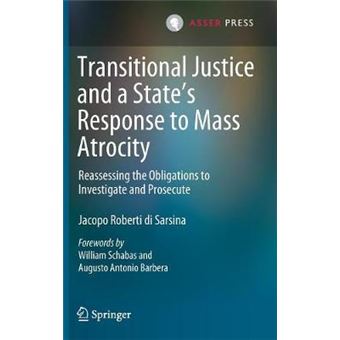
Transitional Justice And A States Response To Mass Atrocity Reassessing The Obligations To Investigate And Prosecute
Jacopo Roberti Di Sarsina
Resumo
Ver tudo
Transitional Justice And A States Response To Mass Atrocity Reassessing The Obligations To Investigate And Prosecute
This book brings a new focus to the ongoing debate on holding perpetrators of massivehumanitarian and human rights violations accountable in countries in transition.It provides a clear-cut and comprehensive legal analysis of the content and nature of astate's obligations to investigate and prosecute as enshrined in the most importanthumanitarian and human rights treaties, it disentangles the common fallacy...
This book brings a new focus to the ongoing debate on holding perpetrators of massivehumanitarian and human rights violations accountable in countries in transition.It provides a clear-cut and comprehensive legal analysis of the content and nature of astate's obligations to investigate and prosecute as enshrined in the most importanthumanitarian and human rights treaties, it disentangles the common fallacy...

Transitional Justice And A States Response To Mass Atrocity...
Resumo
Transitional Justice And A States Response To Mass Atrocity Reassessing The Obligations To Investigate And Prosecute
This book brings a new focus to the ongoing debate on holding perpetrators of massive
Nº de Páginas:
Encadernação: Capa Dura / Hardback
Tema: Human rights
This book brings a new focus to the ongoing debate on holding perpetrators of massive
humanitarian and human rights violations accountable in countries in transition.
It provides a clear-cut and comprehensive legal analysis of the content and nature of a
state's obligations to investigate and prosecute as enshrined in the most important
humanitarian and human rights treaties, it disentangles the common fallacy that these
procedural obligations are naturally rooted and clearly spelled out in the general human
rights treaties, and it explains the flaws in an absolutist interpretation. This analysis
serves to understand whether such procedural obligations, if narrowly construed, act
as impediments to countries emerging from periods of conflict or systematic repression
in the face of contingent circumstances and the formidable dilemmas raised by a
univocal understanding of justice as retribution.
Exploring the latest instances of interpretation and application via an analysis of state
practice, the jurisprudence of treaty bodies, international courts and tribunals, soft
law instruments, and doctrinal contributions, the book also addresses the complex
issue of amnesty, and other transitional justice mechanisms designed to restore peace
and facilitate transition traditionally included in national reconciliation programs,
and criticizes the contention that amnesty is always prohibited by international law.
It also considers these problems from the viewpoint of the International Criminal
Court, focusing on the cases of Uganda and Colombia after the 2016 peace agreement.
Lastly, the volume offers a detailed analysis of techniques that may neutralize relevant
obligations under international law, such as denunciation, derogation, limitation, and
the public international law defenses of force majeure and necessity.
Drawing attention to the importance of a multidisciplinary and practical approach to
these unsettling questions, and endorsing a pluralistic notion of accountability, the
book will appeal to legal scholars and transitional justice experts as well as practitioners,
human rights advocates, and government officials.
Dr Jacopo Roberti di Sarsina is an International Law Expert at the Alma Mater
Studiorum - University of Bologna School of Law, and a dual-qualified lawyer (Italy and
New York). He completed a PhD in public international law, label Doctor Europaeus,
at the School of International Studies, University of Trento, holds an LLM from NYU
School of Law, and read law at the University of Bologna.
Nº de Páginas:
Encadernação: Capa Dura / Hardback
Tema: Human rights
Publicidade
Avaliações dos nossos clientes
Transitional Justice And A States Response To Mass Atrocity Reassessing The Obligations To Investigate And Prosecute
Sê o primeiro a dar
a tua opinião sobre este produto
Características
- Editora
-
T.M.C. Asser Press
- Idiomas
-
Inglês
- Data de lançamento
-
08/04/2019
- Peso
-
560,0
- Colecção
-
Human rights
- Série/Edição Limitada
-
1st ed. 2019
- EAN
-
9789462652750
Publicidade
Publicidade