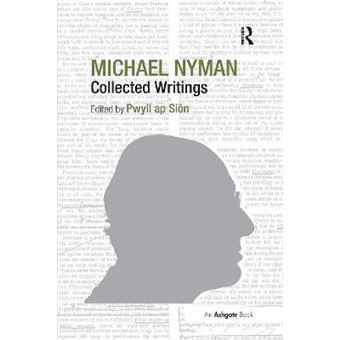
Michael Nyman Collected Writings
Pwyll Ap Siã´N
Resumo
Ver tudo
Michael Nyman Collected Writings
For over three decades Michael Nyman's music has succeeded in reaching beyond the small community of contemporary music aficionados to a much wider range of listeners. An important element in unlocking the key to Nyman's success lies in his writings about music, which preoccupied him for over a decade from the late 1960s to the early 1980s. During this time Nyman produced over 100 articles, covering almost every conceivable musical style and genre - from the Early Music revival and the West...
For over three decades Michael Nyman's music has succeeded in reaching beyond the small community of contemporary music aficionados to a much wider range of listeners. An important element in unlocking the key to Nyman's success lies in his writings about music, which preoccupied him for over a decade from the late 1960s to the early 1980s. During this time Nyman produced over 100 articles, covering almost every conceivable musical style and genre - from the Early Music revival and the West...

Michael Nyman Collected Writings
Resumo
Michael Nyman Collected Writings
For over three decades Michael Nyman's music has succeeded in reaching beyond the small community of contemporary music aficionados to a much wider range of listeners. An important element in unlocking the key to Nyman's success lies in his writings about music, which preoccupied him for over a decade from the late 1960s to the early 1980s. During this time Nyman produced over 100 articles, covering almost every conceivable musical style and genre - from the Early Music revival and the West's interest in 'world' music, or from John Cage and minimalism to rock and pop. Nyman initiated a number of landmark moments in the course of late twentieth-century music along the way: he was one of the first to critique the distinction between the European avant-garde and the American experimental movement, he was the first to coin the term 'minimalism' in relation to the music of (then largely unknown) Steve Reich and Terry Riley, and later Philip Glass, the first to seriously engage with the music of the English experimental tradition and the importance of Cornelius Cardew, and to identify the importance of Art Colleges in nurturing and developing a radical alternative to modernism, and one of the first writers to grasp the significance of post-minimalists such as Brian Eno and Harold Budd, and to realize how these elements could be brought together into a new aesthetic vision for his own creative endeavours, which was formulated during the late 1970s and early 80s. Much of what transformed and defined Nyman's musical character may be found within the pages of this volume of his writings, comprehensively edited and annotated for the first time, and including previously unpublished material from Nyman's second interview with Steve Reich in 1976. There is also much here to engage the minds of those who are interested in pre-twentieth century music, from Early and Baroque music (Handel and Purcell in particular) to innovative features in Haydn, spatial elements in Berlioz, or Bruckner and Mahler's symphonic works.
Nº de Páginas: 396
Encadernação: Capa Mole / Paperback
Tema: Theory of music & musicology
For over three decades Michael Nyman's music has succeeded in reaching beyond the small community of contemporary music aficionados to a much wider range of listeners. An important element in unlocking the key to Nyman's success lies in his writings about music, which preoccupied him for over a decade from the late 1960s to the early 1980s. During this time Nyman produced over 100 articles, covering almost every conceivable musical style and genre - from the Early Music revival and the West's interest in 'world' music, or from John Cage and minimalism to rock and pop. Nyman initiated a number of landmark moments in the course of late twentieth-century music along the way: he was one of the first to critique the distinction between the European avant-garde and the American experimental movement, he was the first to coin the term 'minimalism' in relation to the music of (then largely unknown) Steve Reich and Terry Riley, and later Philip Glass, the first to seriously engage with the music of the English experimental tradition and the importance of Cornelius Cardew, and to identify the importance of Art Colleges in nurturing and developing a radical alternative to modernism, and one of the first writers to grasp the significance of post-minimalists such as Brian Eno and Harold Budd, and to realize how these elements could be brought together into a new aesthetic vision for his own creative endeavours, which was formulated during the late 1970s and early 80s. Much of what transformed and defined Nyman's musical character may be found within the pages of this volume of his writings, comprehensively edited and annotated for the first time, and including previously unpublished material from Nyman's second interview with Steve Reich in 1976. There is also much here to engage the minds of those who are interested in pre-twentieth century music, from Early and Baroque music (Handel and Purcell in particular) to innovative features in Haydn, spatial elements in Berlioz, or Bruckner and Mahler's symphonic works.
Nº de Páginas: 396
Encadernação: Capa Mole / Paperback
Tema: Theory of music & musicology
Publicidade
Avaliações dos nossos clientes
Michael Nyman Collected Writings
Sê o primeiro a dar
a tua opinião sobre este produto
Características
- Editora
-
Taylor & Francis
- Idiomas
-
Inglês
- Número de páginas
-
396,0
- Peso
-
739,36
- Data de lançamento
-
11/11/2016
- Série/Edição Limitada
-
1
- EAN
-
9781138255869
Publicidade
Publicidade