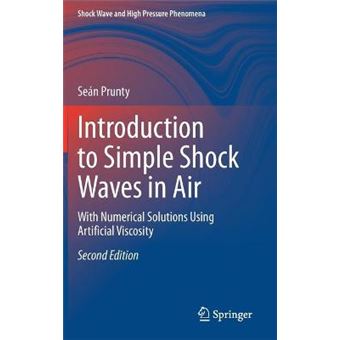
Introduction To Simple Shock Waves In Air With Numerical Solutions Using Artificial Viscosity Shock Wave And High Pressure Phenomena
Seán Prunty
1 Brief outline of the equations of fluid flow 1.1 Introduction 1.2 Eulerian and Lagrangian form of the equations 1.3 Some elements of thermodynamics 1.3.1 Ideal gas equation 1.3.2 The first law of thermodynamics 1.3.3 Heat capacity 1.3.4 Isothermal expansion or compression of an ideal gas 1.3.5 Reversible adiabatic process for an ideal gas 1.3.6 Work done by an ideal gas during an...

Resumo
1 Brief outline of the equations of fluid flow
1.1 Introduction
1.2 Eulerian and Lagrangian form of the equations
1.3 Some elements of thermodynamics1.3.1 Ideal gas equation
1.3.2 The first law of thermodynamics
1.3.3 Heat capacity
1.3.4 Isothermal expansion or compression of an ideal gas
1.3.5 Reversible adiabatic process for an ideal gas
1.3.6 Work done by an ideal gas during an adiabatic expansion
1.3.7 Alternate form of the equations for specific internal energy and enthalpy
1.3.8 Ratio of the specific heats for air1.3.9 The second law of thermodynamics
1.4 Conservation equations in plane geometry
1.4.1 Equation of mass conservation: the continuity equation
1.4.2 Equation of motion: the momentum equation1.4.3 Energy balance equation
1.5 Constancy of the entropy with time for a fluid element
1.6 Entropy change for an ideal gas
1.7 Spherical geometry
1.7.1 Continuity equation
1.7.2 Equation of motion
1.7.3 Equation of energy conservation
1.8 Small amplitude disturbances: sound waves
1.9 Typical sound wave parameters1.9.1 Typical sound intensity in normal conversation
1.9.2 Loud sounds
2 Waves of finite amplitude
2.1 Introduction
2.2 Finite amplitude waves
2.3 Change in wave profile
2.4 Formation of a normal shock wave
2.5 Time and place of formation of discontinuity2.5.1 Example: piston moving with uniform accelerated velocity
2.5.2 Example: piston moving with a velocity >0
2.6 Another form of the equations: Riemann invariants2.6.1 Solution of some first-order partial differential equations
2.6.2 Nonlinear equation
2.6.3 An example of nonlinear distortion
2.6.4 The breaking time2.7 Application of Riemann invariants to simple flow problems
2.7.1 Piston withdrawal
2.7.2 Piston withdrawal at constant speed
2.7.3 Piston moving into a tube
2.7.4 Numerically integrating the equations of motion based on Riemann's method
3 Conditions across the shock: the Rankine-Hugoniot equations
3.1 Introduction to normal shock waves
3.2 Conservation equations
3.2.1 Conservation of mass
3.2.2 Conservation of momentum
3.2.3 Conservation of energy3.3 Thermodynamic relations
3.4 Alternative notation for the conservation equations
3.5 A very weak shock
3.6 Rankine-Hugoniot equations
3.6.1 Pressure and density changes for a weak shock
3.7 Entropy change of the gas on its passage through a shock
3.8 Other useful relationships in terms of Mach number
3.9 Entropy change across the shock in terms of Mach number
3.10 Fluid flow behind the shock in terms of shock wave parameters
3.11 Reflection of a plane shock from a rigid plane surface
3.12 Approximate Analytical Expressions for Weak Shock Waves
3.12.1 Shock velocity for weak shocks
3.12.2 Pressure ratio for weak shocks
3.12.3 Density ratio for weak shocks
3.12.4 Temperature ratio for weak shocks
3.12.5 Sound speed
Avaliações dos nossos clientes
Sê o primeiro a dar
a tua opinião sobre este produto
Características
- Editora
-
Springer
- Idiomas
-
Inglês
- Data de lançamento
-
23/01/2021
- Peso
-
690,0
- Série/Edição Limitada
-
2nd ed. 2021
- EAN
-
9783030636050