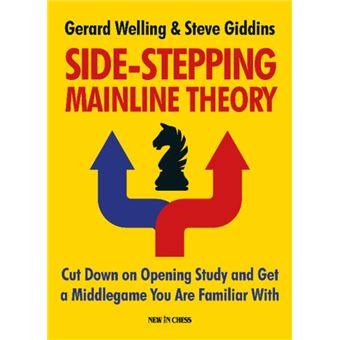
Sidestepping Mainline Theory Cut Down On Opening Study And Get A Middlegame You Are Familiar With
Gerard Welling
Estado :
Novo
Vendido por
País de expedição : Portugal Continental
Comentários do vendedor
Best Offer | Melhor Preço
Resumo
Ver tudo
Sidestepping Mainline Theory Cut Down On Opening Study And Get A Middlegame You Are Familiar With
Spend more study time on whats really decisive in your games! The average chess player spends too much time on studying opening theory. In his day, World Chess Champion Emanuel Lasker argued that improving amateurs should spend about 5% of their study time on openings. These days club players are probably closer to 80%, often focusing on opening lines that are popular among grandmasters. Club players shouldnt slavishly copy...
Spend more study time on whats really decisive in your games! The average chess player spends too much time on studying opening theory. In his day, World Chess Champion Emanuel Lasker argued that improving amateurs should spend about 5% of their study time on openings. These days club players are probably closer to 80%, often focusing on opening lines that are popular among grandmasters. Club players shouldnt slavishly copy...
Outras ofertas

Sidestepping Mainline Theory Cut Down On Opening Study And...
Resumo
Sidestepping Mainline Theory Cut Down On Opening Study And Get A Middlegame You Are Familiar With
Spend more study time on whats really decisive in your games! The average chess player spends too much time on studying opening theory. In his day, World Chess Champion Emanuel Lasker argued that improving amateurs should spend about 5% of their study time on openings. These days club players are probably closer to 80%, often focusing on opening lines that are popular among grandmasters. Club players shouldnt slavishly copy the choices of grandmasters. GMs need to squeeze every drop of advantage from the opening and therefore play highly complex lines that require large amounts of memorization. The main objective for club players should be to emerge from the opening with a reasonable position, from which you can simply play chess and pit your own tactical and positional understanding against that of your opponent. Gerard Welling and Steve Giddins recommend the Old Indian-Hanham Philidor set-up as a basis for both Black and White. They provide ideas and strategies that can be learned in the shortest possible time, require the bare minimum of maintenance and updating, and lead to rock-solid positions that you will know how to handle. By adopting a similar set-up for both colours, with similar plans and techniques, you will further reduce study time. Side-stepping Mainline Theory will help you to focus on what is really decisive in the vast majority of non-grandmaster games: tactics, positional understanding and endgame technique. Gerard Welling is an International Master and an experienced chess trainer from the Netherlands. He has contributed to NIC Yearbook and Kaissiber, the freethinker's magazine on non-mainline chess openings. Steve Giddins is a FIDE Master from England, and a highly experienced chess writer and journalist. He compiled and edited The New In Chess Book of Chess Improvement, the bestselling anthology of master classes from New In Chess magazine.
Nº de Páginas: 272
Encadernação: Capa Mole / Paperback
Tema: Chess
Spend more study time on whats really decisive in your games! The average chess player spends too much time on studying opening theory. In his day, World Chess Champion Emanuel Lasker argued that improving amateurs should spend about 5% of their study time on openings. These days club players are probably closer to 80%, often focusing on opening lines that are popular among grandmasters. Club players shouldnt slavishly copy the choices of grandmasters. GMs need to squeeze every drop of advantage from the opening and therefore play highly complex lines that require large amounts of memorization. The main objective for club players should be to emerge from the opening with a reasonable position, from which you can simply play chess and pit your own tactical and positional understanding against that of your opponent. Gerard Welling and Steve Giddins recommend the Old Indian-Hanham Philidor set-up as a basis for both Black and White. They provide ideas and strategies that can be learned in the shortest possible time, require the bare minimum of maintenance and updating, and lead to rock-solid positions that you will know how to handle. By adopting a similar set-up for both colours, with similar plans and techniques, you will further reduce study time. Side-stepping Mainline Theory will help you to focus on what is really decisive in the vast majority of non-grandmaster games: tactics, positional understanding and endgame technique. Gerard Welling is an International Master and an experienced chess trainer from the Netherlands. He has contributed to NIC Yearbook and Kaissiber, the freethinker's magazine on non-mainline chess openings. Steve Giddins is a FIDE Master from England, and a highly experienced chess writer and journalist. He compiled and edited The New In Chess Book of Chess Improvement, the bestselling anthology of master classes from New In Chess magazine.
Nº de Páginas: 272
Encadernação: Capa Mole / Paperback
Tema: Chess
Publicidade
Avaliações dos nossos clientes
Sidestepping Mainline Theory Cut Down On Opening Study And Get A Middlegame You Are Familiar With
Sê o primeiro a dar
a tua opinião sobre este produto
Características
- Editora
-
New In Chess
- Idiomas
-
Inglês
- Número de páginas
-
272,0
- Data de lançamento
-
16/08/2019
- Peso
-
520,0
- EAN
-
9789056918699
Publicidade
Publicidade