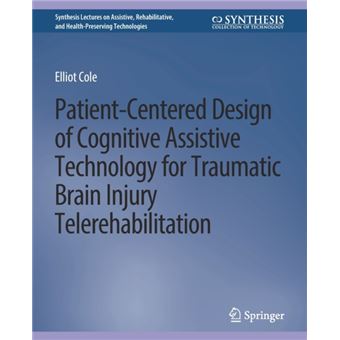
Patient-Centered Design of Cognitive Assistive Technology for Traumatic Brain Injury Telerehabilitation
Elliot Cole
Estado :
Novo
Vendido por
País de expedição : Portugal Continental
Comentários do vendedor
Best Offer | Melhor Preço
Resumo
Ver tudo
Computer software has been productive in helping individuals with cognitive disabilities. Personalizing the user interface is an important strategy in designing software for these users, because of the barriers created by conventional user interfaces for the cognitively disabled. Cognitive assistive technology (CAT) has typically been used to provide help with everyday activities, outside of cognitive rehabilitation therapy. This book describes a quarter century of computing R&D at the Institute for Cognitive Prosthetics,...
Outras ofertas

Patient-Centered Design of Cognitive Assistive Technology...
Resumo
Computer software has been productive in helping individuals with cognitive disabilities. Personalizing the user interface is an important strategy in designing software for these users, because of the barriers created by conventional user interfaces for the cognitively disabled. Cognitive assistive technology (CAT) has typically been used to provide help with everyday activities, outside of cognitive rehabilitation therapy. This book describes a quarter century of computing R&D at the Institute for Cognitive Prosthetics, focusing on the needs of individuals with cognitive disabilities from brain injury. Models and methods from Human Computer Interaction (HCI) have been particularly valuable, initially in illuminating those needs. Subsequently HCI methods have expanded CAT to be powerful rehabilitation therapy tools, restoring some damaged cognitive abilities which have resisted conventional therapy. Patient-Centered Design (PCD) emerged as a design methodology which incorporates both clinical and technical factors. PCD also takes advantage of the patient's ability to redesign and refine the user interface, and to achieve a very good fit between user and system. Cognitive Prosthetics Telerehabilitation is a powerful therapy modality. Essential characteristics are delivering service to patients in their own home, having the patient's priority activities be the focus of therapy, using cognitive prosthetic software which applies Patient Centered Design, and videoconferencing with a workspace shared between therapist and patient. Cognitive Prosthetics Telerehabilitation has a rich set of advantages for the many stakeholders involved with brain injury rehabilitation.
Publicidade
Avaliações dos nossos clientes
Patient-Centered Design of Cognitive Assistive Technology for Traumatic Brain Injury Telerehabilitation
Sê o primeiro a dar
a tua opinião sobre este produto
Características
- Editora
-
Springer International Publishing
- Idiomas
-
Inglês
- Número de páginas
-
139
- Encadernação
-
Capa Mole / Paperback
- Data de lançamento
-
23/03/2013
- Comprimento
-
19,1 cm
- Altura
-
23,5 cm
- Peso
-
315 g
- EAN
-
9783031004667
Publicidade
Publicidade